
The NEM – Part 4: Generation
An overview of generation technologies in the NEM

A reminder that we’re hosting our third birthday party on Friday 20th March at Fargo & Co. in Richmond.
It’s a networking evening, but unlike anything else out there – a powerpoint evening, but make it energy themed and unhinged.
Come along for a laugh, stay for great chats with interesting people and take an energy-themed factlet home to share with your partner/colleagues/unsuspecting children/indifferent pets.
Tickets: https://events.humanitix.com/currently-speaking-is-three
This is a continuation of our NEM explainer series covering the types of generators in the NEM, how they function, the structural basics of the NEM’s participant categories and some considerations for the future.
If you’re new here, start with the first explainer article, or explore the entire series via the menu on the Substack homepage.

Making Currents
Modern power grids are based around one or more core pillars of generation technology:
Thermal generation
Nuclear
Hydro-electric
Solar [photovoltaic] and wind farms (aka ‘renewables’)
… with storage, particularly battery energy storage systems (BESS) becoming increasingly important to enabling high-penetration renewable systems.
The NEM has examples of all these pillars, excluding nuclear.1
There is a long tail of niche or emerging generation technologies which do not feature in the NEM – including geothermal, solar thermal, and different storage technologies – but we’re going to skip over these in the interest of brevity.2
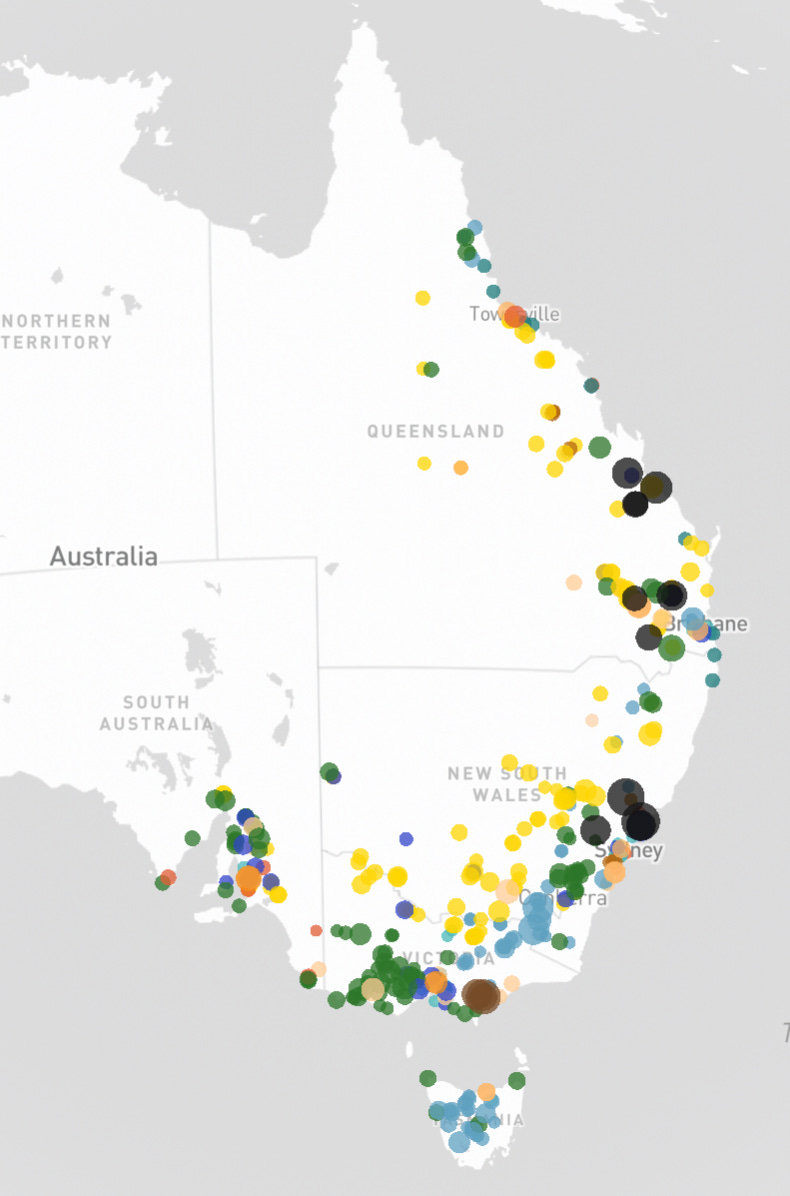
Thermal Plant
Thermal plant covers generation which converts heat energy into electrical energy. This category primarily covers power stations which generate that heat by combusting a fuel source – fossil fuels like coal, gas or oil derivatives; or biomass like wood or bagasse.3 They fall into two sub-categories — those which transfer the released energy to a working fluid, and those which use the released energy directly.

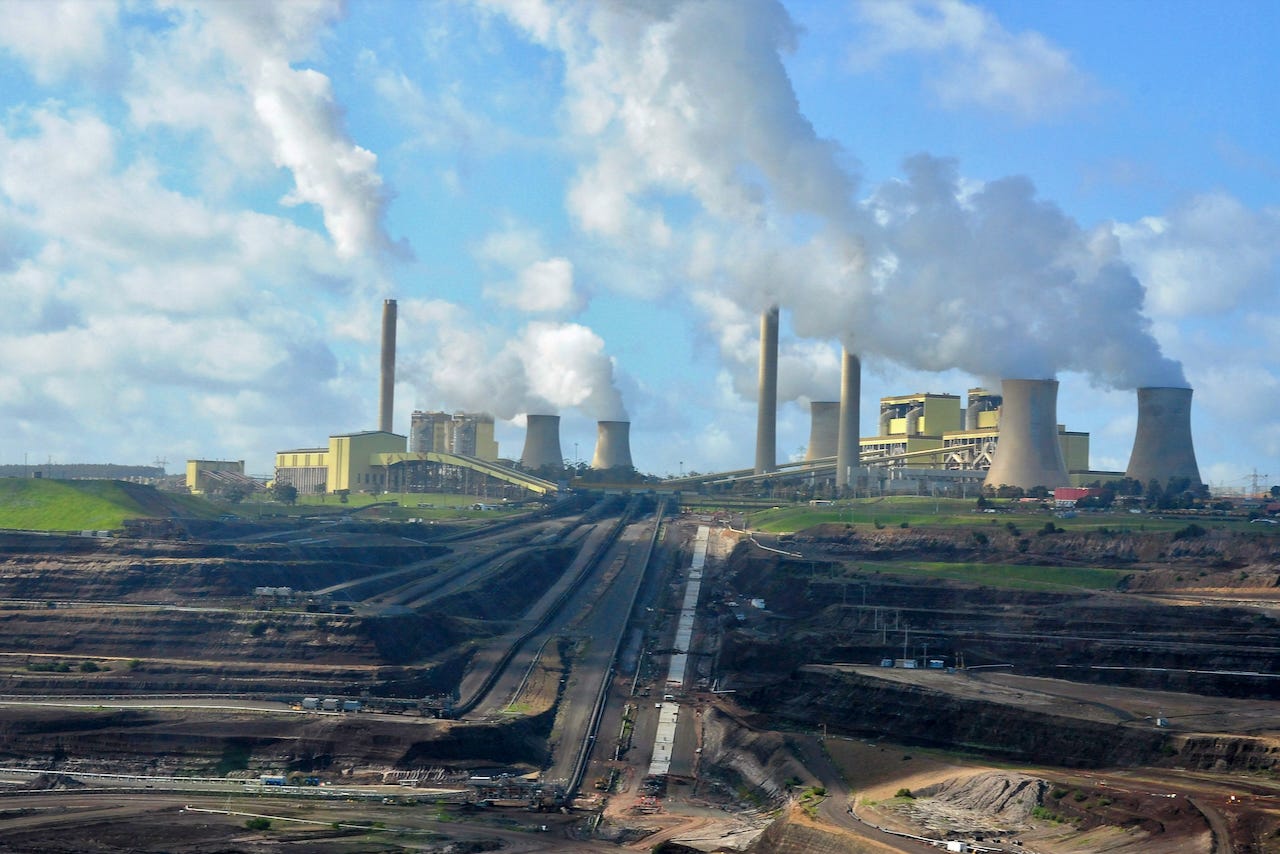
Coal-fired stations operate on the former principle – heat released from the burned coal is used to create steam, which is in turn used to turn a turbine connected to a generator. The same principle can be applied to other fuels – Newport D in Victoria for example burns gas inside of a boiler, and oil-fired power stations were a common feature of the early twentieth century.
Historically the NEM has been dominated by coal-fired stations; although that is very rapidly changing with 15 remaining stations generating 56% of the NEM’s energy in 2025.4
All of the Queensland and New South Wales stations burn black coal, and Victoria’s stations use brown coal. South Australia retired the last of its last coal-fired power stations in 2016 (Northern and Playford B).5 Tasmania has never had any large coal-fired power stations (but it does have relatively small coal reserves).
The majority of the NEM’s operating coal fleet was commissioned in the 1970s and 1980s. Only Queensland has stations commissioned (but largely designed and planned, etc. in the 1990s) after the NEM’s commencement – the four supercritical units commissioned between 2000 and 2007.
The NEM’s fleet of coal-fired units are rapidly heading towards retirement, with roughly half of the remaining fleet set to retire by the mid-2030s.

Examples of generating plant which utilise the released energy include both reciprocating engines – the big brothers of automotive internal combustion engines, and gas turbines – where the energy from gas combustion spins a turbine directly. These units operate in a similar fashion to the jet engines on an aeroplane.6
Gas turbines can further be categorised as open-cycle or closed-cycle.
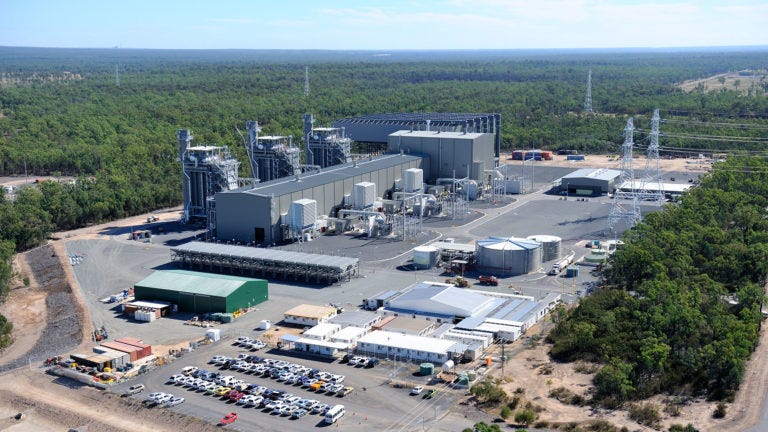
Open cycle gas turbines (OCGT) burn natural gas within a specialised turbine in order to generate electricity, with the exhaust gases from the burnt gas simply emitted to the atmosphere. OCGTs are typically low-ish cost to build but expensive to run and thus primarily serve as peaking generation.
Combined Cycle Gas Turbines (CCGT) take the exhaust gases from the gas turbine and run them through a heat recovery steam generator (HRSG)7. This generated steam is then utilised in a conventional steam generator. CCGTs are significantly more capital intensive then OCGTs, but by scavenging the waste heat CCGTs can achieve much higher thermal efficiencies – 50% and above. This higher efficiency improves the economics and enables CCGTs to be run in base load or intermediate configurations.
CCGTs are often arranged with multiple gas turbine and a single steam turbine – for example the 660 MW Darling Downs CCGT in Queensland features three GTs and a single ST.
Many CCGTs can also often be operated in an open cycle mode where the waste heat is simply exhausted to atmosphere without going through the HRSG – this enables CCGTs to operate in a peaking mode.
Every region in the NEM has both OCGT and CCGT units, the latter of which was particularly in vogue in the 2000s and is less capital and resource intensive (and has easier environmental and planning permitting) than coal-fired units.
The role of gas in the evolving energy system is one of the hotter transition topics, with an increasing majority agreeing that gas units will have an important role to play during short but critical moments.8
Hydro-electric
Hydro-electric power is generated by utilising the potential energy of moving water to spin a turbine. Hydro-electric generation was the first large scale form of generation developed in the late 19th century.
Hydro units come in three primary flavours, all of which feature in the NEM:
Conventional units – water stored in an elevated dam. The amount of energy which can be extracted from the water is a function of the height of the dam above the turbine outflow (known as the head) and the volume of water in the dam.
Pumped-storage – water is moved between lower and upper reservoirs, utilising cheap or excess energy to move the water and then releasing it later.
Run-of-river — hydro systems without a significant reservoir can still utilise the potential energy of constantly moving water through a river or aqueduct. These tend to be much smaller scale than conventional hydro units, especially so in the NEM.
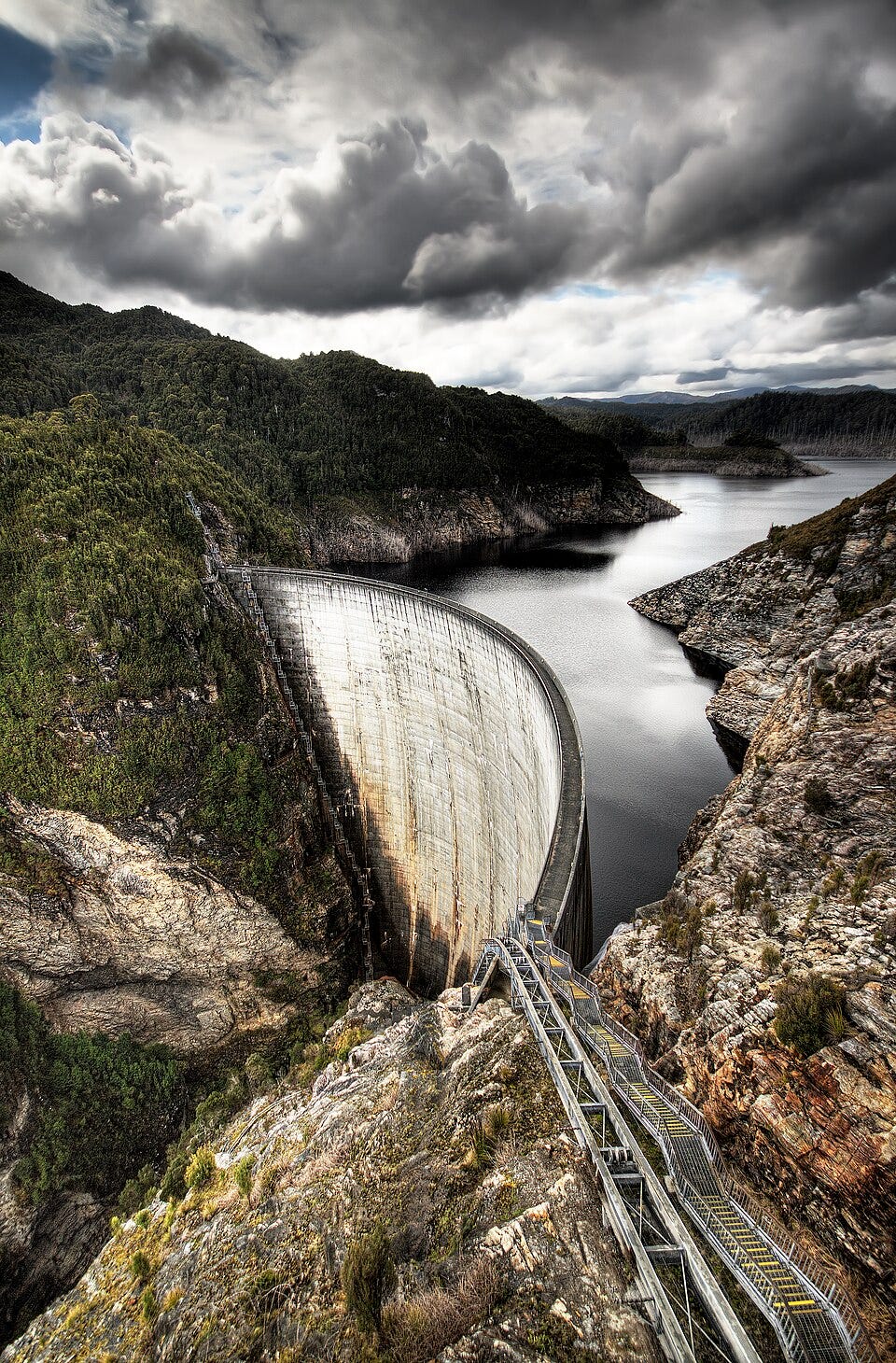
Tasmania is famous(?) for having a lot of hydro-electric power – 70+% in some years. If power tourism™️ is your thing, the Waddamana A power station is Australia’s first hydro-electric plant (producing a thumping 7 MW in 1916) and is now a museum. Bonus fun(?) fact, Tasmania has no pumped hydro units… yet.
Outside of Tasmania Australia has two significant hydro-electric schemes; the the Snowy Mountains Scheme in the New South Wales Kosciuszko National Park features both conventional and very large pumped storage.9 More pumped storage is currently under construction in the Snowy 2.0 scheme.
Unfun fact – the Snowy units were originally operated via a joint arrangement between New South Wales and Victoria; when the NEM was born ownership was transferred to the federally-owned Snowy Hydro and there was a bonus SNOWY1 region (abolished in 2008).
The second is the Kiewa Scheme in the Victorian Alps, coming off Mount McKay (Falls Creek) via four individual stations. The Kiewa Scheme was proposed in the early twentieth century, but one of the first decisions of the brand new SECV in 1921 was to nix the project in favour of developing Yallourn and the Latrobe Valley coal reserves. It was eventually built between 1938 and 1961, when the project was again cancelled thanks to recession. AGL took ownership in the early 2000s and finished the fourth station (Bogong) in 2009.
Queensland has two significant hydro-electric plants – the conventional Barron Gorge outside of Cairns10 and the Wivenhoe pumped storage west of Brisbane. Hydro is back on the table in Queensland with the Borumba pumped storage and currently-cancelled-but-just-wait-for-the-next-election-cycle Pioneer-Burdekin project.
Notably, South Australia has no hydro-electric assets.
A final note on hydro – because the units don’t operate at elevated temperatures like thermal units, they don’t suffer the same fatal degradation mechanisms (primarily creep). Where thermal units have maximum operational lives in the 60-70 year range, some hydro-electric assets are expected to be operational for up to a century.11
Solar and Wind (Variable Renewable Energy)
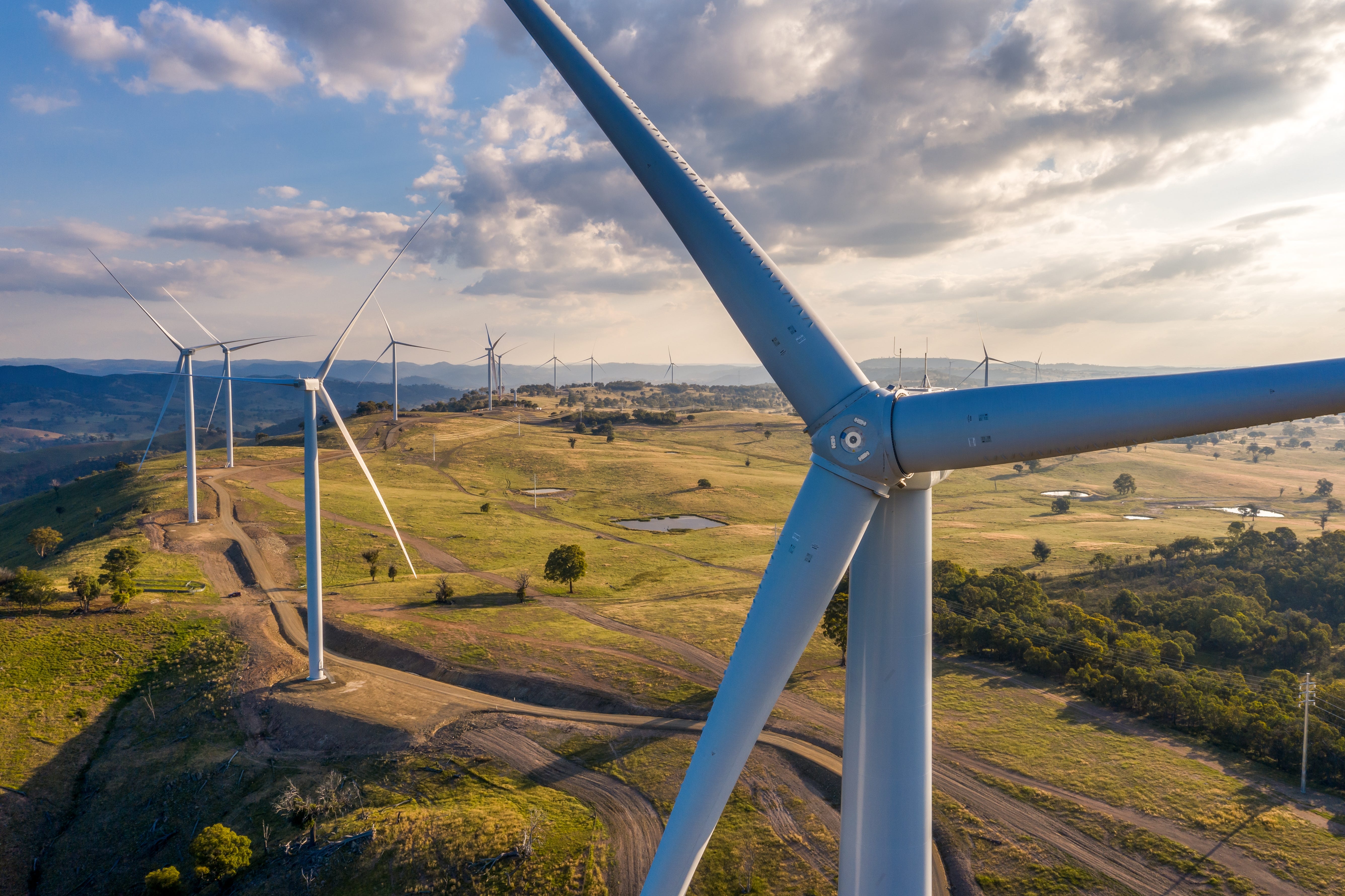
One of the defining features of electricity grids in the twenty-first century has been the shift to large scale renewable energy. This has been driven by rapid developments in the technologies and huge cost reductions, alongside the requirement to decarbonise.
Australia has excellent wind and solar potential, and wind and solar farms have dominated the new build generation landscape since the late 2000s.
Three pertinent features of large-scale renewables relative to the legacy thermal and hydro-electric units worth noting:
The location of wind and solar resources are not necessarily aligned with the existing transmission grid (built around legacy thermal and hydro-electric asset locations). This makes windy or sunny locations with existing transmission access very valuable and is driving the expansion of the transmission system.
Wind and solar farms are non-synchronous – they produce DC power, which is converted to AC at the required voltage and frequency settings via an inverter.12
The build out of renewables has seen a rise of new entrants to the market. Almost all of the coal and hydro-electric units were built by the former state electricity commissions (or the Queensland government) and sold off to companies with experience operating generation plant (and largely staffed with former electricity commission employees). Renewables have seen a wide range of new companies entering the NEM, with varying experience and knowledge levels.
Australia currently does not have any offshore wind farms, and depending on who you ask and what mood they’re in, might never.
Battery Energy Storage Systems
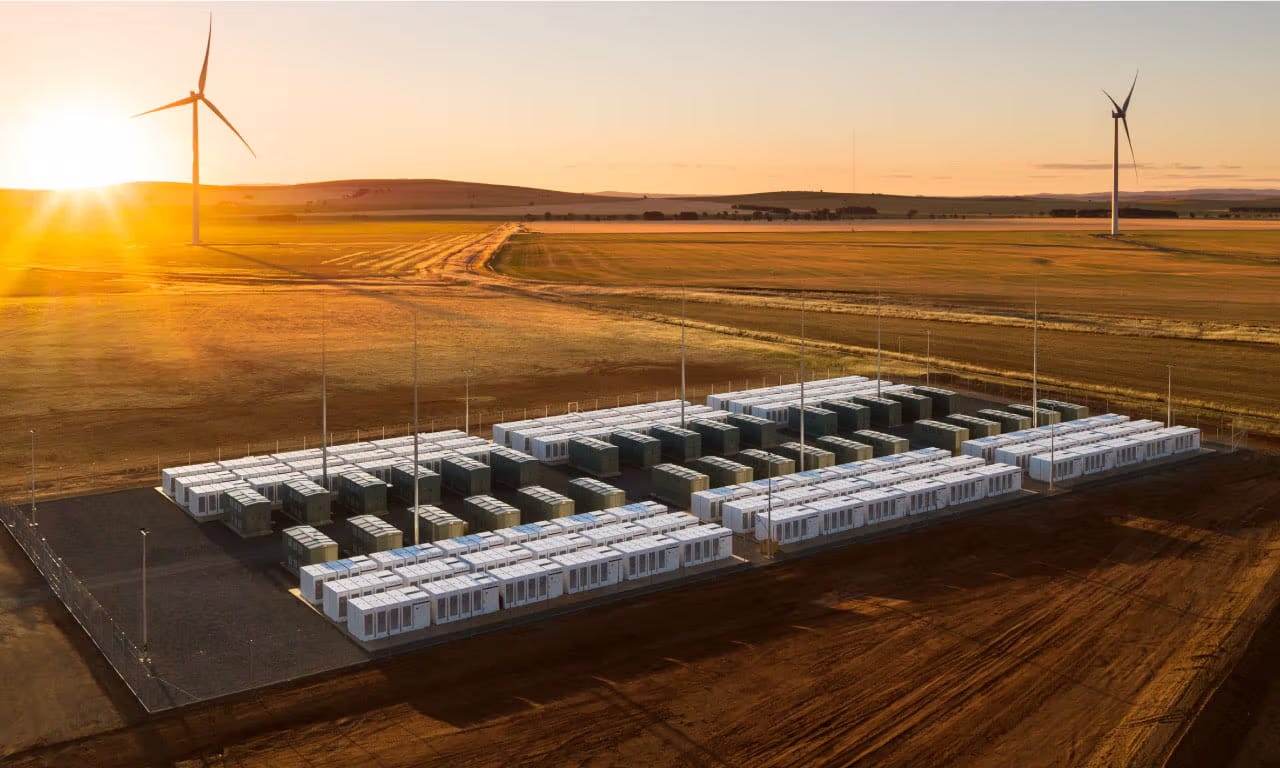
The first large-scale battery to enter the NEM was the Hornsdale Power Reserve in South Australia (late 2017), in possibly the only productive example of two chronically online egos Tweeting at one another. At the time it was the biggest battery in the world – 100 MW/129 MWh (later increased to 150 MW/194 MWh).
There are now some 4 GW worth of large-scale batteries operating in the NEM, with another 7 GW worth of committed projects currently in the pipeline.
Batteries support the grid by shifting energy from periods of low value (e.g. we have too much energy being produced during the middle of the day) to more valuable periods (e.g. the evening peak).
Until recently, all of the operational batteries have been between 1-2 hours in duration. This is sufficient to capture both daily arbitrage value and short term volatility; however longer duration batteries are beginning to be commissioned, starting with 4 hour and then 8 hour batteries.
The other emerging story around batteries is hybrids – batteries coupled with a solar or wind farm. As the economics of standalone solar has collapsed with low or negative pricing during daylight hours, co-located batteries which can shift the solar energy around – without having to source the energy from the grid – become appealing. The same thing can be done with wind, although solar + BESS hybrids are currently the dominant technology.
Are we on Schedule?
The NEM’s gross pool energy-only design requires generators to sell all sent-out energy into the grid (the ‘pool’). These generators are classed as Market Generators.
There is also a Non-Market Generator category for certain exempt generators who sell all of their energy to an offtaker at the same point of connection – effectively embedded generation. These generators by definition do not receive the spot price for any energy sent out.
There are four key registration categories for generators13:
Scheduled – generators which participate in the central dispatch process. These units ‘bid’ into the market, and if cleared by the price setting process are ‘dispatched’. Operational information like bids and actual output down to a 4-second level are public information (with a delay).
Semi-scheduled – a registration category specific to renewable generators which rely on intermittent resources (e.g. wind, solar), introduced in 2009. Generators are subject to (almost all) the same rules as schedule generators, with allowances for forecasting windiness and sunniness.
Non-scheduled – units which do participate in the central dispatch process. Operational information is typically not available publicly. Units below 5 MW nameplate capacity are automatically eligible, with eligibility for units up to 30 MW under certain conditions.
Bidirectional Unit (BDU) – A newly introduced category for storage technologies in 2024, primarily aimed at BESS. Prior to the BDU category storage was required to be independently registered as both a load and a generator.
Generation registration categories are defined in the National Electricity Rules Chapter 2… with more technical requirements living across a series of AEMO procedures.
Paradigm shift
Historically power systems have been based around the concept of baseload, intermediate and peaking generators.

The change to a renewables-based system, where the short run marginal cost is close to zero but the fuel availability is weather dependent is driving a new classification system, one adopted in the recent Nelson Review – bulk energy, shaping (intraday storage) and firming (generation).
This change to generation which relies on intermittent resource availability has increased the importance of understanding the distinction between nameplate or installed capacity — measured in Megawatts, and produced energy – measured in Megawatt-hours (or realistically Gigawatt-hours).
Although it’s common to reference the nameplate capacity in megawatts, and the AEMO dispatch numbers are always presented in megawatts, as the system comes to be dominated by energy-constrained assets the Megawatt-hours are increasingly important figure to pay attention to.
The difference between these two – the nameplate rating and energy produced – is described by the capacity and availability factors. The capacity factor is the ratio between a unit’s actual produced energy and the theoretical output if the unit was running flat out at its nameplate capacity whereas the availability factor represents the ratio between the total amount of energy a unit could have produced and the theoretical output if the unit was running flat out at its nameplate capacity.
For wind and solar farms the availability factor reflects the variability of wind and solar availability and are something like 30-40% and 15-30%, respectively. For thermal units the availability factor effectively represents the maintenance and outage rate, and for modern units should be somewhere in the 80-90% range.
There’s plenty of room at the bottom
Outside of the rise of renewables, the other big emerging story of generation in the modern NEM is the rise of invisible assets – non-scheduled generation. In the old world it wasn’t feasible to build a mini coal or gas power station. Small-by-power-system-standards (e.g. 1–30 MW) diesel generators have been around for some time, but the cost of fuel and other operational considerations generally limit their economic payback.
However the plummeting cost of solar and batteries has completely changed the nature of what is possible – small (sub-5MW) systems which are an order of magnitude or two easier to build and connect to the grid than their larger scheduled brethren.
The non-scheduled category was designed to lower the barrier to entry with less onerous permitting and compliance requirements, which it has absolutely done, in the process creating a new set of headaches on the other side.
Not for lack of trying – nuclear’s viability in the Australian context has been assessed every decade since the 1950s, with the findings always amounting to some variation of “economically unviable, but let’s revisit this conversation in a bit”. It truly is the fast train of power systems.
“Brevity“ and Currently Speaking in the same sentence lol.
Geothermal and solar thermal plant also fall into the thermal category, but they don’t burn a fuel.
A quick note to distinguish between stations and units. Modern large power stations utilise a unitised design – e.g. the Loy Yang A station in Victoria has four individual units. Each of these units has a separate boiler connected to a 500 MW turbine, and largely individual balance of plant – a failure in one boiler or turbine unit (usually) doesn’t bring the entire station offline. Kogan Creek is the notable exception in Australia, consisting of a single boiler and a whopping great 750 MW turbine (also the biggest coal-fired unit in Australia).
South Australia has Sub-bituminous coal reserves, just in case you were wondering. Which sit somewhere in the “nice brown coal but shitty black coal” zone.
And there is an entire class of “aero-derivative” gas turbines.
An HRSG is a specialised form of heat exchanger. The tubes are often finned to maximise thermal transfer from the exhaust gases to the water.
There is however broad consensus that the Morrison government’s post-COVID era ‘gas-led transition’ was Extremely Fucking Dumb™️.
The Snowy is one of the most significant engineering and social achievements in this country. Constructed over 25 years it set records for engineering feats like tunnelling, and was notable for the large numbers of immigrants employed, changing the social fabric of Australia.
Bonus power station tourism and gunzel nerdery – take the Kuranda Scenic Railway for fantastic views of Barron Falls and cheeky view of the power station.
AEMO has the expected closure dates for a bunch of Tasmanian hydro units as 2100, by which stage I expect we will have at least 3 functional fusion startups.
Wind farms could be built as synchronous units, but are generally built as non-synchronous generators in order to decouple the wind speed from the required generator speed.
There are additional registration categories for things like virtual power plants (VPPs) and demand response, as well as generators which participate only in ancillary services.
Surprisingly, given to the topic, I did laugh out loud while reading this. Note to self - add waddamana hydro station to ‘must see’ list.
This series has been a wonderful read. Please keep writing - you’re producing great stuff!