
The Whitehouse
A story about the SECV, asbestos, a nightclub and AI.

Currently Speaking must issue a mea culpa. I think this might be our first, which yeah, I’m as surprised as you are.
In the last edition of the Short Circuits #15, I asserted that a Facebook page advertising coffee at the “Sir John Monash Museum” out the back of Yallourn W was an odd AI catfishing thing.
The actual story is both way more interesting and way weirder.
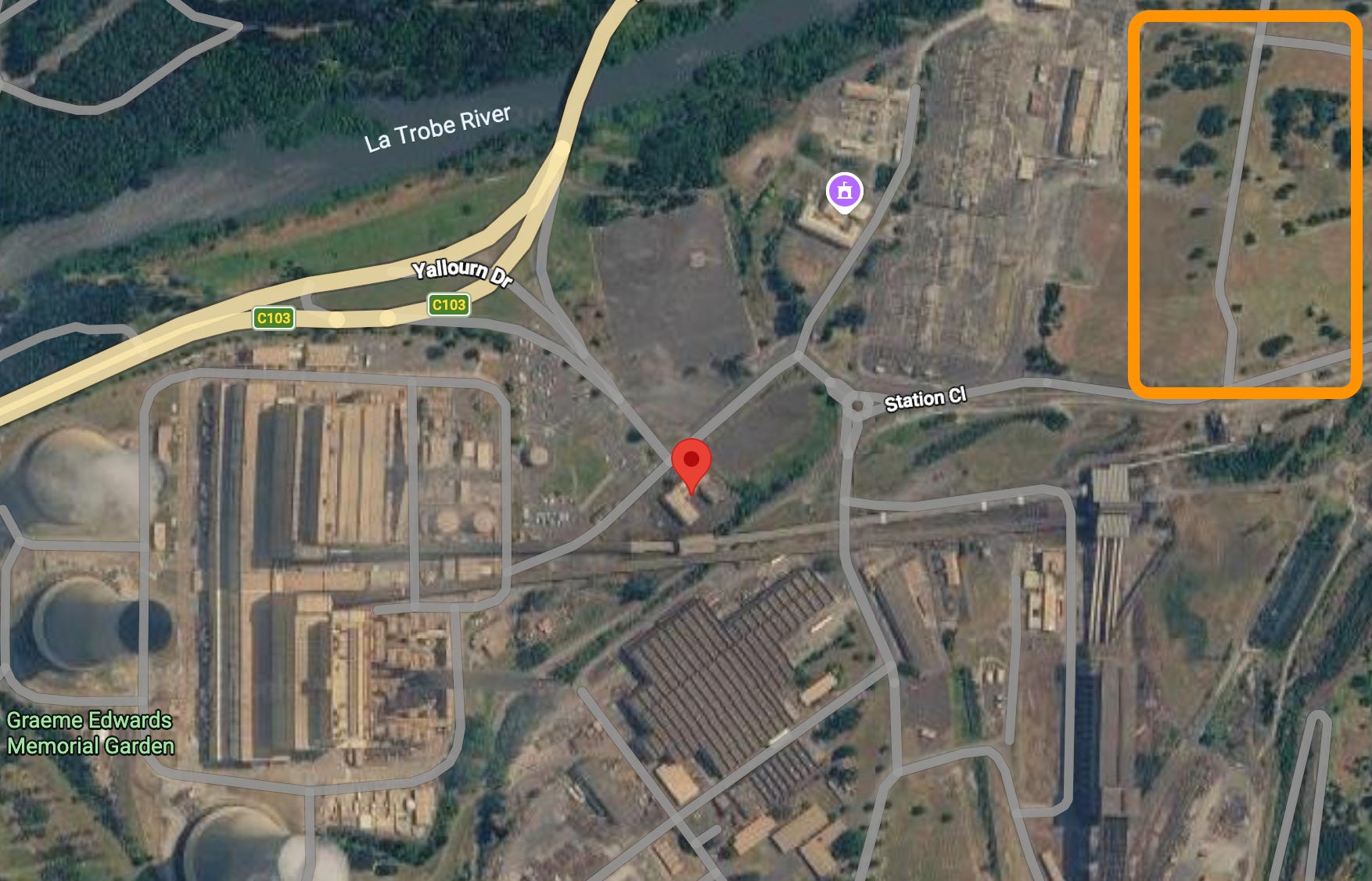
To set the scene, and provide some context, the satellite view above shows the current state of the Yallourn power station complex in the Latrobe Valley, Victoria. The modern station, Yallourn W, is in the lower left and the approximate location of the original stations (A, B, C, D, E stations) is the orange box in the upper right.1 The last of these stations (E station) closed in 1989 and the site was subsequently demolished.
30 Yallourn Dr – the address listed in the Facebook post – is a tired looking 1970s era administration building at the location of the red marker. However at the purple marker lies a grand old building with ionic columns, just like the Facebook post.2
The Birth of the SECV
The State Electricity Commission [of Victoria] was born in 1919 to wean Victoria off the imported black coal from New South Wales (and lower quality black coal from southern Gippsland) and investigate the options for a more stable native power generation industry. New South Wales coal supplies had been subject to interruptions from industrial action (also the war) and Victoria was keen to understand how it could exploit its hydro-electric resources or brown coal (lignite) reserves in the Latrobe Valley.3
By 1921 the SECV had evolved and instead of the original board of commissioners it was governed by a single chairman, the venerable Sir John Monash4. It had also solidified its purpose and pathway; hydro-electric power had been nixed in favour of developing the brown coal resources — plans for the development of the Kiewa Scheme were shelved and it was decided to build a new type of power station utilising the vast reserves of brown coal beneath the Latrobe Valley’s fertile soils.5
This new brown coal-fired power station and the accompanying town to house the workers were named Yallourn – a word constructed from the Woi-wurrung word yalleen (“brown”) and the Bunurong word lourn (“smoke” or “fire”, but sometimes contemporaneously translated as “coal”). Construction of the power station began in 1921, with the first 12.5 MW unit of Yallourn A operational in June 1923.6
The birth of a brand new power station, one which held outsize significance to the newly formed State Electricity Commission, also deserved an administration building grand enough to oversee the planning and development of the power station complex (which grew to include B, C, D and E stations by the 1960s), the briquette works and the township itself.
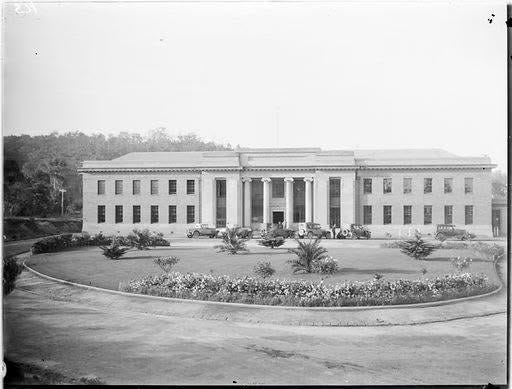
Construction of this administration building was complete by 1923 with staff moving in on 1 September 1923. The building was designed by the SEC’s chief architect AR La Gersch in the Inter-war Academic Classical style (hence those big ionic columns from the Greek influence), not the Style Moderne which came into fashion slightly later and was a featured heavily in the buildings in the Yallourn township.
And at some point this grand building became known as the Whitehouse… I can’t imagine why.7
So yes, the building is real, but image on Facebook is AI, Including the malformed powerlines above.8
The Death of the SECV
With the exception of the newer E station, by the 1960s the Yallourn units were getting long in the tooth and the Commission’s future lay to south with the much larger, much shinier Hazelwood — the new crown jewel in the SECV’s fleet.
And although Yallourn W was developed not long after Hazelwood entered service, the future of Yallourn was forever changed — the Commission had determined that the existing Yallourn mine was running out of coal and the township would need to be ctrl+A deleted to make way for the coal beneath its streets. This was originally proposed for roughly 2000, but the timeline was rather more accelerated and the last residents were out of the town by 1982.
The original town of Yallourn — once considered a master stroke of planning in the Garden City style — is now a giant hole in the ground to continue feeding the boilers of Yallourn W.
I get the sense that around this time the centre of power (both virtually and quite literally) in the Valley shifted away from Yallourn and towards the newer and more advanced stations to the south and east. Particularly the Loy Yang complex which was one of the most expensive infrastructure projects in this country, completely consuming the capital works budgets of the SECV for many years.
In this context, I can see how the grand old administration building, built at the very beginning of the SEC, may have begun to feel old fashioned and fallen out of favour. It’s possible even that maintenance may have begun to slip a little as the SEC’s attention drifted away to coal-winning in other parts of the Valley.
In fact, the Loy Yang megaproject was the beginning of the end for the Commission — huge cost overruns and a changing culture of microeconomic reform led to corporatisation of the SECV and significant job losses across the Valley in the late 1980s.
In 1992 the newly elected Kennett government upped things a notch and began the process of privatisation — the SECV was carved up into generation, transmission and distribution/retail and sold off to the highest bidders — largely international interests.
Each of the power stations were packaged up and sold off to new owners for tidy sums — Yallourn W (including the mine) was sold for $2.4 billion in 1996.
After the sales of the core assets and electricity businesses in the mid-1990s, all that was left of the SECV was an administrative shell to deal with the rats and mice and things that private buyers weren’t so keen on.9
One of these administrative tasks was to find a buyer for the old Yallourn administration building.
This is where the story gets weird and amazing.
A Second Life
According to a comment on LinkedIn, the original plan had been for the corporate functions of Yallourn Energy (the holding company for Yallourn W) to move into this building.
However this period saw the rollout of desktop PCs and the old cathode ray tube (CRT) monitors. Remember those powerlines which run overhead? Apparently they caused interference with the monitors. Amazing.
The story told to me is that the administrative team tasked with moving the building along considered the options for refurbishment; the building at this stage was without water or sewerage and – particularly ironically – without power (the utilities were connected to the old Yallourn station site being demolished).
Also, it was riddled with asbestos. So the administrators drafted up a contract for sale, put all those caveats right up front and still found a buyer for around $40,000 in 1996.
The new owners plastered over the friable material, reconnected the utilities and this grand old building out of the back of a former power station and in the shadow of an operating one became a nightclub.
… and when that didn’t work out a brothel.10
… And then later a pub.
Rebirth
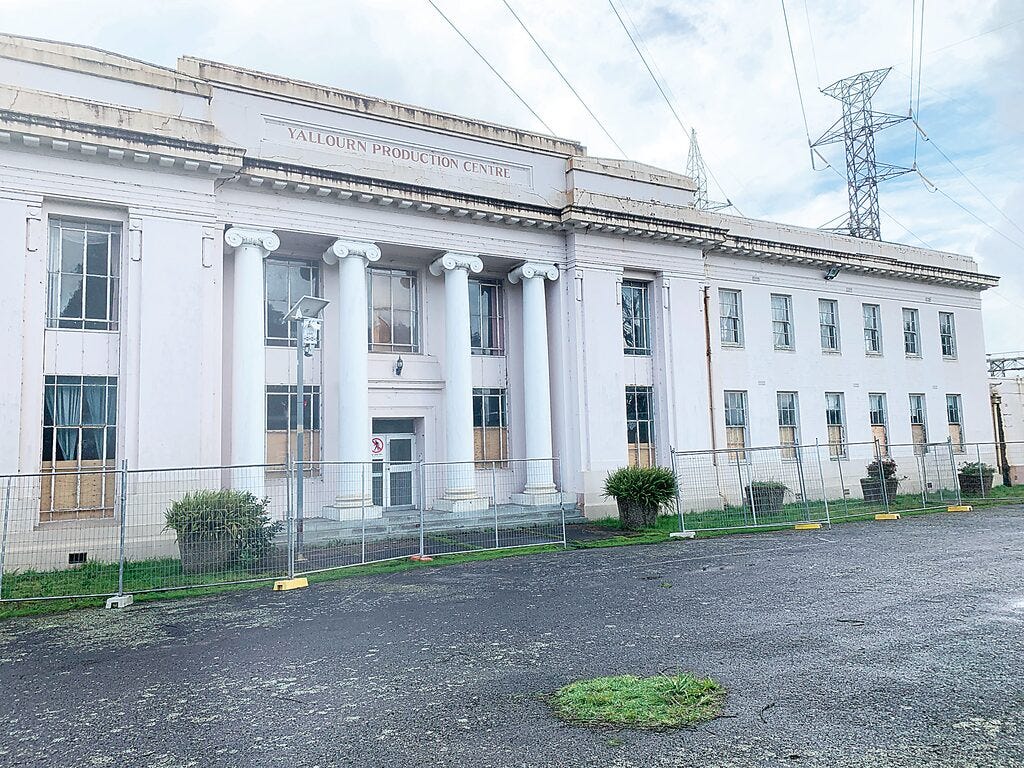
After its less than salubrious misadventures in the 90s and 2000s, the 100-year old building was pretty tired. It had seen some things.
In 2021 a company purchased part of the old Yallourn site including the old building to develop hydrogen from lignite.11 This sale breathed new life into the old building, with the Newborough Men’s Shed relocating to the building and volunteers beginning the long process of restoring the derelict building.
Which brings us to 2026. The Sir John Monash Museum (the unofficial one) are the new custodians of the Whitehouse and are telling the story of Yallourn and the SEC. And also making AI posts.
I’ve poked fun at the AI, but in all earnestness it's truly commendable what this community group is doing. The SECV and Yallourn are historically significant to Victoria, and the changes of the 1980s and 1990s changed the Valley and left deep scars.12 I suspect that commemorating and celebrating the contributions of Yallourn is actually part of a grieving process.
The grand old building has been heritage listed since the 1990s, but now the Whitehouse has fitting occupants to see it into its second century.
The current station is Yallourn W, which stands for west… because it’s sited to the west of the original power complex. Thank you for coming to my TED talk.
The marker also serves as a gentle reminder that Google Maps addresses in rural Australia are often a bit she’ll-be-right.
There’s a much longer story here, but brown coal is a pain in the ass to burn at scale. It has a low energy content and it’s extremely wet. Figuring out how to build power station using the stuff was an achivement.
According to Geoffrey Serle’s biography of Monash, it was pronounced MOHnash, but he wasn’t too particular about correcting people who called him MONash. After his death, his family accepted MONash as the pronunciation, confirming so with the university named in his honour. Anyway, something to think about next time you’re on the freeway.
The Kiewa Scheme was eventually built later, but the smaller run-of-river Sugarloaf-Rubicon Project was built in the 1920s, taking advantage of a planned irrigation scheme. A hydro-electric scheme in the Strathbogies was also investigated around this time but never progressed. The new SECV also decided to build Newport B station, next door to the existing 25 Hz A which had been built by the Victorian Railways.
Yallourn A consisted of 6x 12.5 MW turbines for a stonking great 70 MW. Sizeable for the time!
As the SEC administration building, in a time before computers, it was responsible for handing out wages. One comment on a Facebook post referred to it as “Bullshit Castle” which is just 🧑🍳😘
One observation I will make is that boomers seem to love AI. Especially image generation – the chintzier the better. The broad and obvious observation here is that embrace of AI is inversely correlated to economic and job security, but I think this is something different entirely. Like the sheer of joy of prompting AI to “generate an image of the Yallourn Production Centre but make it super pretty” warms the cockles of boomer hearts in ways unappreciable to younger digital native generations with passable Photoshop skills.
Reminds me of an early job I had where the company-wide safety alerts for quite serious incidents like “Kangaroo strike in company car” or “Burn injury suffered in laboratory” used WordArt headings. Shadow effect and all. The mind boggles.
Fun stuff like asbestos workers comp, former power station demolition, complicated site remediation and the out-of-the-money Alcoa Portland contract.
Nothing says sexy like “80 year-old asbestos-riddled former administrative building out the back of an operating power station”.
ECT have subsequently sold the site this year, as their focus shifts away from hydrogen and brown coal.
Psychologically and quite literally in the huge holes in the ground from the open cut mines.
I should also note, that much like urban explorers deep in the forgotten stations of the metro discovering the graff kids have been already been there, Marcus has of course already been here: https://wongm.com/2011/11/yallourn-power-station-then-and-now/
a correction on privatisation. many people get this wrong. Joan Kirner LAB Gov started privatisation, not Jeff Kennett.
1992 (Joan Kirner Labor Government): The first significant privatisation step occurred when the government sold 51% of the Loy Yang B power station, which had been part of the SECV system. This is generally regarded as the beginning of electricity privatisation in Victoria.
1992 Election: Labor lost office and Jeff Kennett became Premier.
1993-1999 (Kennett Liberal Government): The SECV was broken up into separate generation, transmission, distribution and retail businesses, with most of these entities subsequently sold to private owners. This was the large-scale privatisation that most Victorians associate with the end of the SEC.