
Book Review: Warring Tribes
Part history, part autobiography. Definitely polemic.

Arguably one of the required pieces of reading for true NEM nerds is Robert Booth’s Warring Tribes. Released in 2000 (and a revised edition in 2003), it chronicles the evolution and circumstances of the various State Electricity Commissions in the latter half of the twentieth century and the development of the National Electricity Market in the 1990s.
The book is long out of print, although you can find a copy at many university and state libraries.
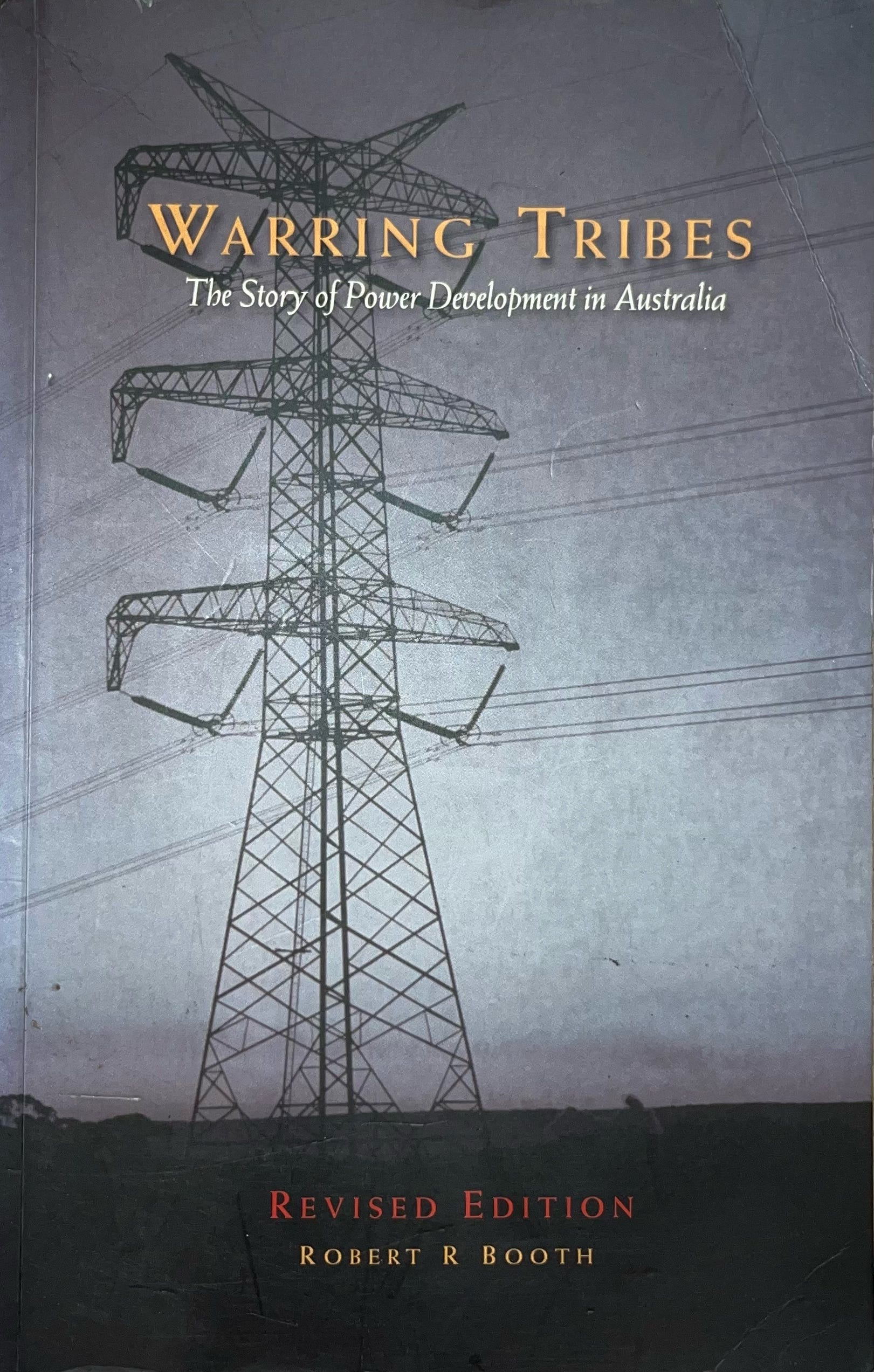
An unusual book
Although a somewhat niche topic, a number of histories (and historiographies) on the Australian electricity supply industry have been published. They can generally be described as falling into one of three categories:
Academic works written by historians some time after the events have transpired. A good example of this is Ken Thorton’s 2015 PhD thesis covering the history of the Electricity Commission of NSW (1888-2003).1
Official or sanctioned historiographies of the various State Electricity Commissions or specific power stations and schemes. There’s quite a suprising number of these, ranging from glossy coffee table books (ahem, Snowy and EA) through to slightly more scholarly works. There’s a surprising number of Australian electricity history books in this category, but some good examples are the SECV sanctioned history of Yallourn Power station (written by Colin Harvey, a former superintendent of the station), or the two part series on the history of the Queensland electricity supply industry, 1888—1988 (authored by the historian Malcolm Thomis and commissioned by the QEC notionally as part of the Australian bicentennial celebrations).
Sociological histories, focussing on the human stories associated with the electricity industry. Siobhán McHugh’s The Snowy: A History or Prue McGoldrick’s “Yallourn Was…” are great examples of this type of work.
What makes Booth’s Warring Tribes interesting is that it largely falls outside of these categories – it is not academically rigorous enough to fall into the first category and it was most definitely not sanctioned by any of the authorities involved (it was self published). Much of the book’s content is guided by Booth’s own experiences and knowledge developed during his long career, and by speaking to his contemporaries.
Booth stands out as unusual author — his experience, technicality and perspective made him well positioned to write about the NEM development. Very few people who were in the room2 ever write about their experiences in such a manner. The fact that he was willing to be openly critical about the whole thing is even more unusual.3
The Warpath
The book is broken up into roughly four sections:
A somewhat fawning description of Sir John Monash’s vision for a ‘linking-up’ of the then nascent power schemes of the capital cities in the early twentieth century; followed by a description of some of the key elements of power systems – e.g. fuel sources, contracting structures and inter-regional trading arrangements.
A chapter each on the history of each of Australia’s electricity commissions, although Victoria gets three chapters because of its importance to the story of privatisation and the development of the NEM… and because Booth spent most of his career in the SECV.
A chapter on “The English Experiment” detailing how the UK developed and trialled an energy-only design before shifting to the current capacity market design. This chapter serves as something of a warning and setup for the remainder of the book.
The last section of the book is focussed on the politics and machinations during the 1990s which saw the development of the NEM and its proto-markets. He finishes by highlighting the core challenges of electricity market design, and his specific nitpicks over the adopted design of the NEM.
The revised edition published in 2003, includes additional even saltier material:
A telling of the disastrous early days of the Californian electricity market and Enron’s shenanigans.
A critique of the Parer review (published 2002) and an alternative history chapter where he rewrote the final report to his liking.
Booth stands as one of the few vocal opponents of the NEM – less so privatisation of government assets (there are several notable contemporaneous critics) – but of the market design itself. He strongly believed that an energy-only design was wrong, and the outcomes of the 1990s clearly moved him strongly enough to rail against it.
Oh. Also the consultants. He really gives them a serve.
And in case it’s not clear, the title Warring Tribes refers to the fractured state of the Australian federation. Booth lays plenty of blame on the self-interested politics of the states – from the early years of the twentieth century, the inefficient protectionism of the Victorian and New South Wales electricity commissions in the 1970s and 1980s, through to the horse trading which went on in the 1990s. Plenty of politicians and their advisors cop a serve.4
The Rub
Warring Tribes is not without its faults — in places it blurs the line into autobiography and some parts venture beyond polemic into straight up score settling5. And, yes, Booth had very strong negative opinions on the decisions taken during the privatisation of the State Electricity Commission of Victoria and the development of the NEM, although he fundamentally supported the interconnection of the states. He wasn’t against the privatisation of the Sate Electricity Commissions per se, but he was clearly unhappy enough with the resulting outcome that he was motivated to fire up the dictation software and go HAM.
You mightn’t agree with all (or any) of Booth’s evaluation of the NEM’s design shortcomings (I don’t); and there are both blindspots in his recounting of and different ways of interpreting the events of the 1990s. There are also more complete histories of each of the Australian state electricity commissions, although not in a single book with a cohesive narrative.
But the book still presents a rare insight into the history of Australia’s electricity supply industry from someone extremely senior who had held positions in multiple state electricity commissions and was intimately knowledgeable with the NEM development process.
Perhaps what was most striking to me when I first read Warring Tribes is how many of the challenges, concerns and criticisms of the NEM still hold true some 25 years after it was originally published. We’ve come a long way, but there are clearly unresolved structural issues with the market obvious to those who care to look.
Luckily we’ve gotten pretty good at holding major reviews into the design and function of the NEM…
Ken Thornton worked in the ECNSW at Liddell and Eraring, but his PhD covers a much broader subject matter going back to the early days of electricity in NSW.
There’s an open question over precisely how many rooms Booth was in, but there’s no disputing that he was well qualified to write about the topic.
Oh, spoiler alert.
…but not as much as the consultants!
I would be lying if part of me doesn’t admire him for taking the approach of countless former Australian Prime Ministers and refusing to bury the hatchet… instead picking it up and taking a few good swings.