
Astroturfing the Rainforest
What do a cassowary sanctuary, a Riverina farmer and NMAS have to do with one another?

Did you know that Currently Speaking merch is the perfect Christmas gift? Aesthetically appealing, endlessly comfortable and with a winking nod to those in the know.
All purchases help us physically, spiritually, emotionally, mentally and financially. Consider how you could be playing a part in help bring the nichest stories in energy to life by encouraging rash purchases of long out-of-print books, or hours trawling through junk AI regulatory submissions.https://currentlyspeaking.theprintbar.com/
In October 2024 the Australian Energy Regulator submitted a rule change to amend the National Electricity Rules; ERC0404 Removing the requirement to publish transmission information guidelines is about as dry as rule changes come.
Clause 6A.17 of the NER prescribes the information that the AER must collect from Transmission Network Service Providers on an annual basis. These information guidelines were last updated in 2015.
In early 2024 the AER reviewed their information requirements and developed a new set of reporting requirements – the Annual Information Orders – which have been modernised and expanded to also include distribution networks and interconnectors.
In light of this expanded information gathering clause 6A.17 is redundant – there’s no value in collecting duplicate information. The National Electricity Law also provides the AER with sufficient powers to collect the required information from regulated businesses without requiring the NER.
Are you still awake? This is riveting stuff!
So the AER proposed that clause 6A.17 be scrapped, and that the rule change process be expedited (completed within 6 weeks) because of the straight forward nature of the proposed changes, and to get the rules in effect prior to 1 April 2025 to avoid duplicate work for AusNet’s next regulatory cycle.
The proposed rule change received only two submissions.
One from Rainforest Reserves Australia, and one from Lynette LaBlack.
Rainforest Reserves Australia
Rainforest Reserves Australia is a registered charity which has been operating since 2016.
Based in far north Queensland, they’ve been involved in cassowary rehabilitation programs and various environmental conservation efforts relating to the Atherton Tablelands.
But around 2023 the group seems to have embarked on new ventures, when they spearheaded local opposition to the Chalumbin / Wooroora Station Wind Farm. The farm was was denied an environmental permit in early 2024.
Since that win, the organisation has become a vocal opponent of renewables projects of all types and shapes across all regions – the majority of their anti-renewable advocacy work is a long way from the Tablelands.
Since then the RRA has been associated with the broad anti-renewables and pro-nuclear movement including the lobby group Nuclear for Australia, conservative think tanks the Institute of Public Affairs and the Centre for Independent Studies, and wealthy patrons like Trevor St Baker and Dick Smith.
The organisation was founded by Phil and Carolyn Emms, but Steven Nowakowski, a professional nature photographer, is the public face of the the group’s anti-renewables advocacy arm. The submissions (more on those in a bit) are all authored by Dr Anne Suse Smith, a wildlife photographer and conservationist based in the Whitsundays.1
Lynette LaBlack
There’s much less information available about Lynette LaBlack, but what is known is that she’s a grain farmer from the Riverina region of southern New South Wales. And she really, really hates renewaBULLS2. Much like RRA her advocacy started locally, with a 2022 submission related to the alleged toxicity of the Wagga North Solar Farm
Since then LaBlack has become a vocal opponent of a wide range of renewable projects and broader energy system issues nationally.
You can get a clear sense of her opinions and perceived role in the big picture in the interview below.
Many of her submissions have been associated with an organisation named Save Our Surroundings Riverina, but also in at least one instance Save Our Surroundings Bundaberg.3

Astroturfing
Astroturfing, for the uninitiated, is the process of creating orchestrated campaigns which have the appearance of grassroots organisations in order to give the impression of large scale public sentiment and hide the true actors.
And while I believe that RRA and LaBlack are both genuine grassroots groups, they stand out amongst the broader milieu of anti-renewables advocacy for speed running a pathway from concerned locals to conducting a large-scale carpet bombing campaign of dubious submissions to every electricity industry consultation imaginable.
Any by every consultation imaginable, I mean every. Fucking. Consultation. The Guardian has previously reported on these efforts, but the RRA is not exactly hiding anything; their website has a link to a public Google Drive containing all of their submissions – 124 (and counting) over the course of the last 18 months.
From the obvious, like 60 individual submissions against solar, wind or battery projects across the entire NEM (and at least one green hydrogen project), to the tangential like “objections against virtual power plants”4 and ARENA’s Battery Breakthrough Initiative5, to my absolute favourite – a submission on AEMO’s Non-Market Ancillary Services transitional services consultation6. 🤦
Lynette LaBlack has not consolidated her output anywhere – I counted 35 separate submissions before I lost interest; but like the RRA she’s made submissions far and wide, from Glenellen Solar Farm in her backyard and Cellars Hill Wind Farm in Tasmania, to issues seemingly irrelevant to her situation like Powercor’s 2026 regulatory submission7 and the ERC0378 Accelerating Smart Meter Deployment rule change.8
Reading through the submissions from these organisations three things are clear:
The submissions are full of technical language and complicated arguments which are absolute mumbo jumbo;
No argument is too tangential; and
There is no regulatory process, rule change or engineering work stream that these people won’t put unashamedly put their hand up and say “I have no fucking idea what FCAS stands for, but I still have an opinion on why transitional services contracts are bad”.
Honestly, you’d be hard pressed to find another organisation in the energy sector which has made as many submissions, in such a short period of time, across such a broad range of topics; let alone have that level of internal expertise to confidently and knowledgeably comment on each of these matters in a constructive way.
Clause 6A.17
Which leads us back to ERC0404 and the proposed deletion of NER clause 6A.17, where two grassroots community organisations apparently have very strong views.
This specific rule change, more than just about any other, highlights the absurdity of the entire situation. An arcane and routine rule change to amend the electricity rules attracted strongly worded submissions opposing the entire process. These strong views are based on misconceived ideas, because it’s abundantly clear that neither submission had even the most basic understanding of the topic, or had bothered to do any actual background research.
The other absurdity here, primarily in RRA’s case, is the use of AI to just crank out slop. In the clause 6A.17 deletion submission for example the RRA’s submission argues that the entire rule change is about removing transparency of public information, which they then argued would erode public trust due to 'underhanded regulatory practices’, of which they cite the Enron scandal as one such example. That’s a phenomenally long bow to draw, even if you did think that the deletion of the clause would lead to lower transparency from the TNSPs.
And just for good measure the submission contains a handful of references which don’t exist, like:
Productivity Commission. (2023). Electricity Network Regulation.
which seems to be a hallucinated conjunction of the Productivity Commission’s 2013 Electricity Network Regulation inquiry, and the AER’s 2023 Electricity Network Performance report. Good work AI, I’m glad we’re trashing our economy and rewiring the grid for work this valuable.
Also, for what it’s worth, and I find this quite funny, when the AER was developing the Annual Information Orders process in early 2024 they didn’t receive any feedback from consumer groups. So they explicitly sought out the opinion of Energy Consumers Australia, who were basically neutral on the matter, noting that it “would likely have minimal consumer impacts.” Truly scary stuff watching the AER quietly erode the public’s trust with their underhanded regulatory practices!
You’re the Voice
There’s a number of threads to tug at here — the ability to weaponise AI to turn out voluminous amounts of garbage on topics with barely a scrap of domain knowledge; the broad coalition of vested interests and wealthy benefactors sitting behind these grassroots groups; or the radicalisation of these groups from concerned local citizens to aggressively vocal activists on a campaign to save the nation from itself. Also the bad spelling, weird punctuation and longest of long bows.
But the thread I’m most interested in is the concerted effort to abuse what are open and egalitarian community consultation processes into a megaphone for generic anti-renewable beliefs.
Australia ranks just outside the top 10 in the global rankings of functional democracies. Having a transparent and robust submissions process for government and quasi-government agencies is a core part of this.9
Community groups should absolutely have a voice – this country is not immune from inappropriate development in the renewables sector, poor community consultation or ill-considered rule changes. And there needs to be a process to call these things out.
But spamming every possible consultation with AI-generated rantings about tangential, inconsequential and irrelevant arguments is a misuse of this system and a waste of everyone’s time.
And while the people within these groups might think that what they’re doing is an important, even noble task; making inane submissions regarding DNSP regulatory resets or AEMO transitional services arrangements is just shouting into the void. On the other side some staffer or consultant will open the submission, see “unable to submit through AEMC form – Lynette” and aggressively roll their eyes.
Ironically it’s also likely to erode the credibility of these groups such that when there is inappropriate development, we’re much less likely to pay attention to their concerns.
A sort of vexatious version of Chicken Little.
Her 2019 PhD thesis is titled Resilience and Wellbeing Through Photography: How Might Images Influence Community Capacity Building?
NGL, as a pithy slogan it kind of slaps.
Bundaberg is a long way from the Riverina, to state the obvious. But also Save Our Surroundings has been used as an organisation in a range of other communities, from Romsey to Redbank Plains as seen in the submissions regarding the Wagga Wagga Battery Recycling Facility.
The ERC0352 Integrating price-responsive resources into the NEM rule change. The RRA submission contains this wonderfully long, long bow:
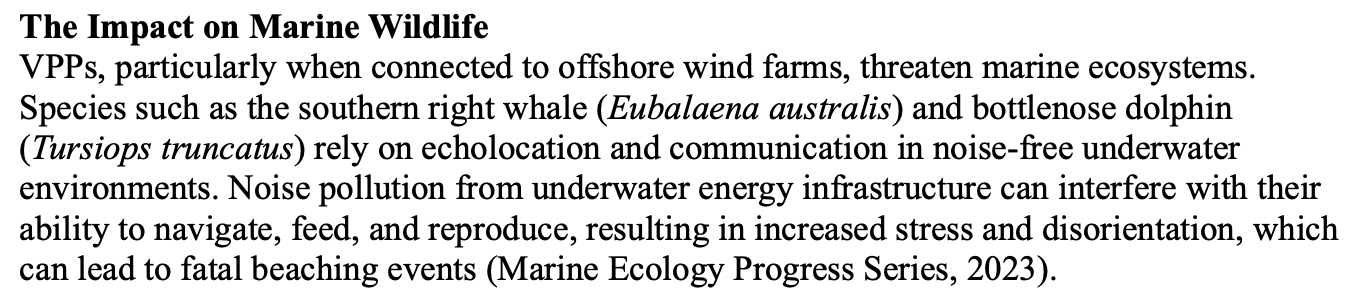
I’m sure the AEMC was deeply concerned about the operation of VPPs utilising power from Australia’s non-existent offshore wind farms.
I was unaware ARENA took public submissions on funding initiatives. Dear ARENA staff, prepare yourself for the wave of Currently Speaking spam headed your way!
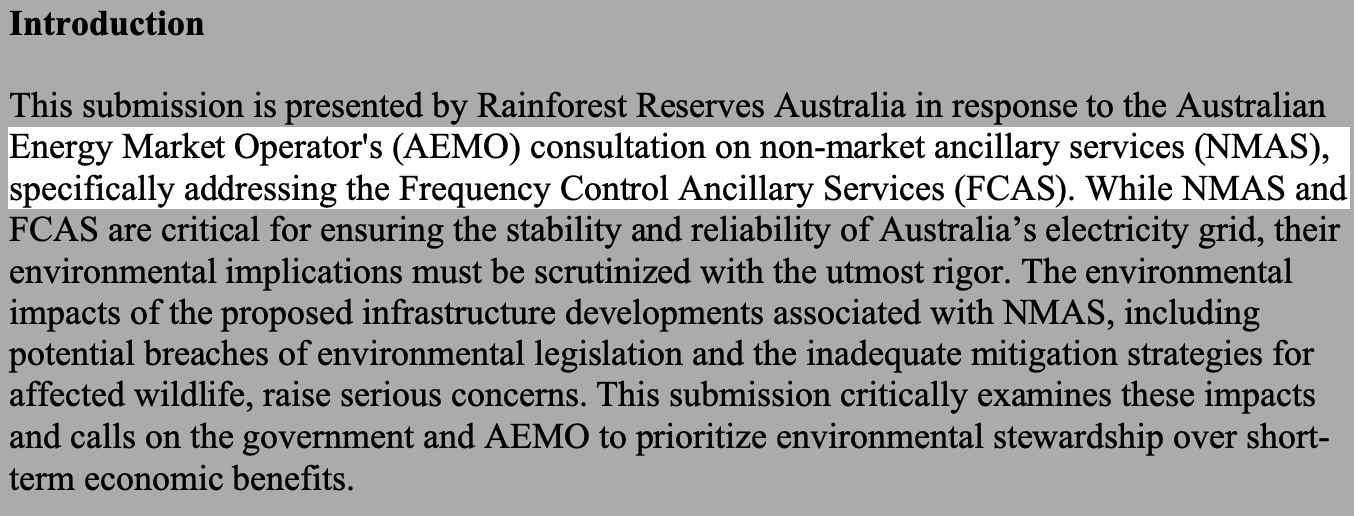
What RRA’s submission was actually addressing in unclear, and their submission is not listed on the project page; but the submission date aligns with closing date for submissions. Their submission opens with this absolute pearler:
She actually made submissions for the regulatory resets for each of the five Victorian distributors. Highlights include her unfettered criticism of the foreign ownership of most of these companies and that Australia should pursue energy independence via “New High-Efficiency Low-Emissions (HELE) coal Plants”, something which will be difficult for Jemena to implement, but I’m nonetheless excited to watch their progress.
Oh and *chef’s kiss* she is calling for a royal commission into “all Regulators including AER, the ISP, and network business collusion”. Is the Integrated System Plan a regulator, or just a document worthy of scrutiny? Hard to say, but bring on the royal commission.
Worth highlighting that there is quite a stylistic difference between RRA and Lynette’s submissions. RRA submissions are written in a fairly dry professional tone (consistent with how most AI tools write out of the box), whereas Lynette’s are something else. There’s BOOMER CAPITALISATION, **random -punctuation usage!! and some language which is at least adjacent to the sovereign citizen movement.
As much as you might like to lob a brick through a politician’s window, it’s better for everyone if you can write a letter first.
I don't know whether to laugh or to cry, but I did nearly choke on my lunch reading about the existential threat that VPPs pose to the Southern Right Whale. Thank you for reading this dross Alex so the rest of us don't have to (except for unfortunate bureacrats in places like the AEMC).
Both amusing and concerning, I'm all for freedom of speech, but probably best to know WTF you're talking about before picking up a megaphone. Thanks for sharing your thoughts Alex.